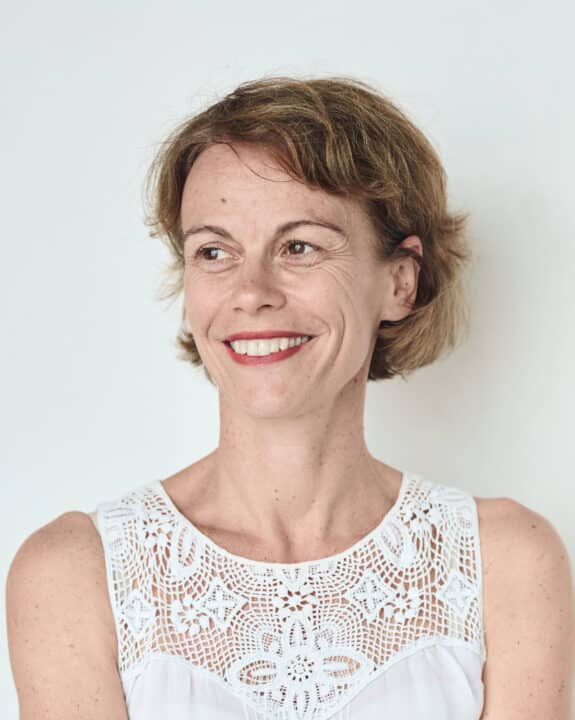
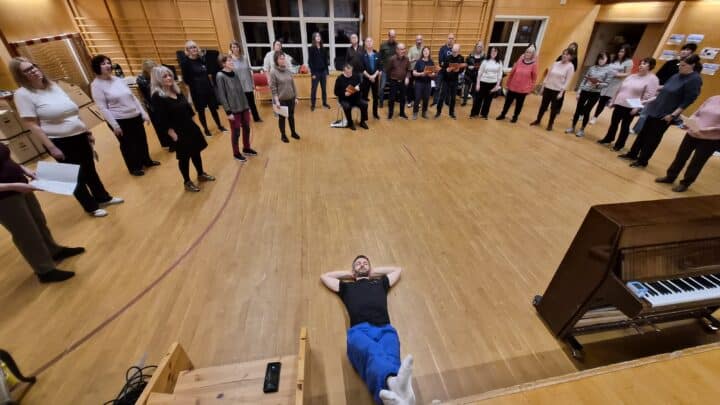
Get to know the choreographers behind Insight!
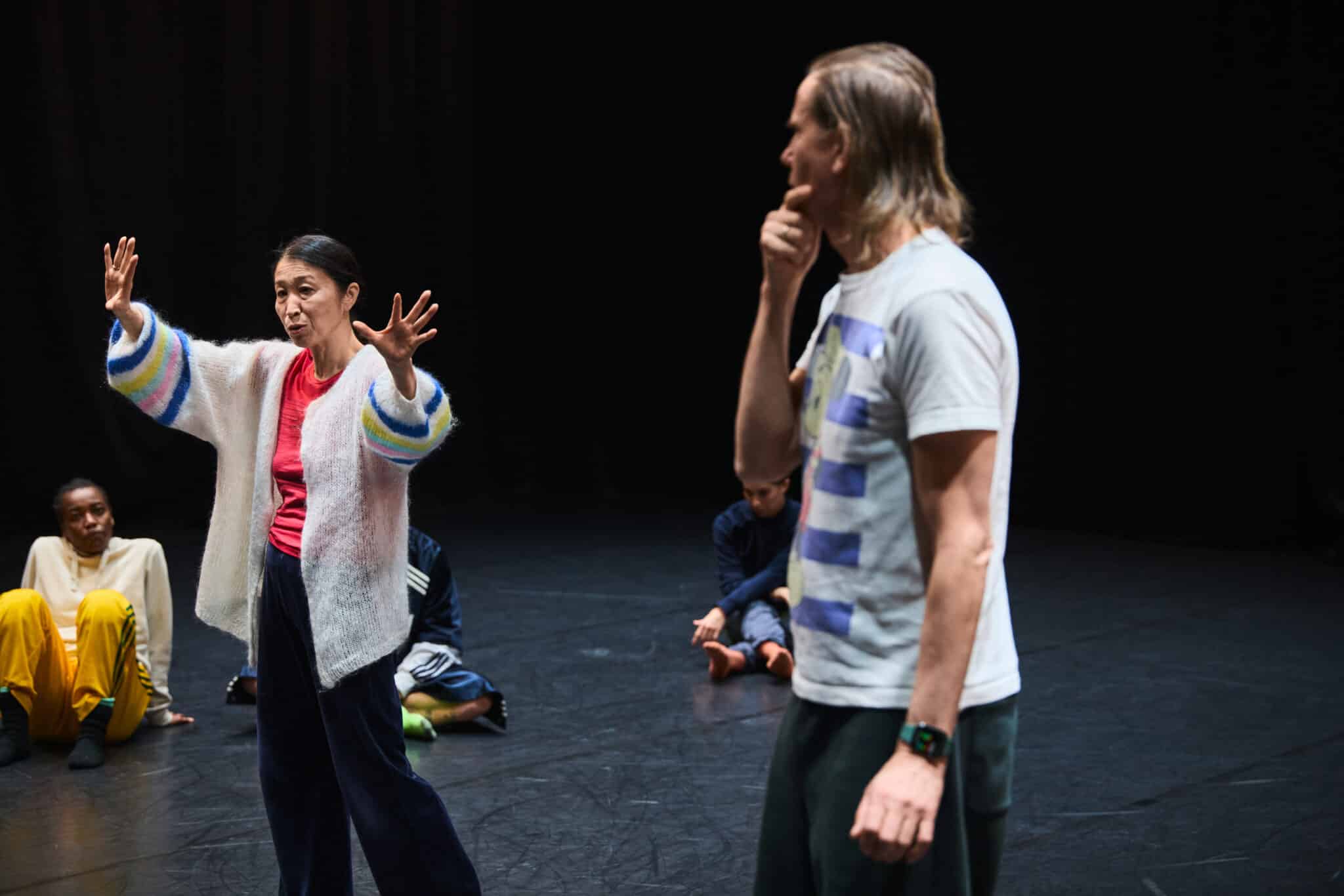
Heine Avdal and Yukiko Shinozaki are the choreographers behind Insight. In this interview, they share their backgrounds, their collaborative working process, and how the relationship between the individual and the collective is explored through movement, light, and sound.
Can you tell us a bit about your backgrounds, and how you first began working together?
Heine:
My background in dance began with ballroom dancing as a child, followed by breakdancing during my teenage years with friends in our group, Crazy Rockers. I later continued my education at KHIO in Oslo and at P.A.R.T.S. in Brussels. This mix of social, street-based, and formal training continues to shape how I approach movement, collaboration, and choreography today.
Yukiko:
I studied classical ballet in Tokyo from the age of six until I was eighteen. After graduating from high school, I decided to stop dancing and moved to the U.S. because I wanted to explore something different. I chose psychology as my major at Portland State University in Oregon. The university also had a dance department, and it was there that I discovered contemporary dance. In Japan, I had only danced ballet, so this was a real eye-opening experience for me.
After finishing my BA, I moved to New York to pursue a career as a dancer. I also began creating my own projects and presented work in venues such as Judson Church and St. Mark’s Church.
We first met during a workshop with Meg Stuart in Brussels in 1996. During that workshop we became a couple, and soon after Meg invited both of us to join her company, Damaged Goods, where we worked as dancers from 1997 to 2000.
When you begin a new piece, what usually comes first for you – a physical practice, a situation, a question, or something else?
Each production has its own starting point. Sometimes we make work for a theatre space, and at other times we create site-specific projects.
We often begin with a few visual images or key words that inspire us. These ideas usually come from everyday life, and from there we start improvising in the space.
At other times, a strong idea emerges precisely from uncertainty – from not knowing. By entering spaces or situations through observation, awareness begins to sharpen. In these moments, ideas can arise simply by noticing small details that might otherwise be overlooked.
We try to discover the work through the process itself and often work very intuitively. Rather than making detailed plans, we allow the work to unfold together with our collaborators. There is also an element of chance – chance encounters and chance discoveries – and this sense of discovery is central to how we work.
Insight is a title that points toward attention and awareness. What drew you to this title, and how does it resonate with the work you are making here?
For us, insight is the ability to gain a deeper understanding by paying close attention – to ourselves, to others, and to what is unfolding around us. In the work, this is reflected in how the dancers listen, respond, and question through movement.
This is a work created with a large ensemble. How has working with the dancers of Carte Blanche Company influenced the piece?
In Insight, the choreography grew out of a close collaboration with the dancers. The movement language developed in response to who they are – both individually and as a group – and could only have taken this shape with this particular ensemble.
At the start, we were a little nervous about working with such a large group. But collaborating with the dancers of Carte Blanche has been a very positive and energising experience. They are highly skilled, generous, and deeply engaged. Their curiosity and attentiveness actively drove the work forward.
It has been exciting to observe how they processed the tasks we proposed and how they brought their own perspectives into the material. Through dialogue, shared responsibility, and trust, we created this piece together.